Understanding Property Taxes Across Southern Alberta Communities
If you’re shopping for a home in Calgary or one of the surrounding communities, you’ve probably compared home prices, commute times, schools, neighbourhoods and maybe even how much yard you’re getting for your money.
But there is another cost that deserves a spot on the list: property taxes.
Property taxes can vary from one Alberta municipality to another, and the difference can become significant over the years. However, comparing property tax rates isn’t quite as simple as finding the community with the lowest percentage.
Your actual property tax bill depends on two major factors: your property’s assessed value and the tax rate set by the municipality.
So, what does that look like across Southern Alberta?
Let’s compare Calgary, Airdrie, Cochrane, Okotoks, Chestermere and High River using the 2026 residential property tax rates.
How Do Property Taxes Work in Alberta?
Before comparing communities, it helps to understand what you’re actually paying for.
Your property tax bill generally includes a municipal portion and a provincial education portion. Depending on the municipality, there may also be other local requisitions included on the bill.
The municipality collects the provincial education portion and sends it to the Government of Alberta. It isn’t money the municipality gets to spend on local services.
Your basic calculation looks something like this:
Assessed property value × applicable tax rate = property tax bill
This is why two homeowners with the same tax rate can have very different tax bills. A $500,000 assessment and a $750,000 assessment are obviously going to produce different tax amounts even when the rate is identical.
2026 Property Tax Comparison: Calgary vs. Surrounding Communities
Using 2026 residential rates, the communities in this comparison generally fall into the following range:
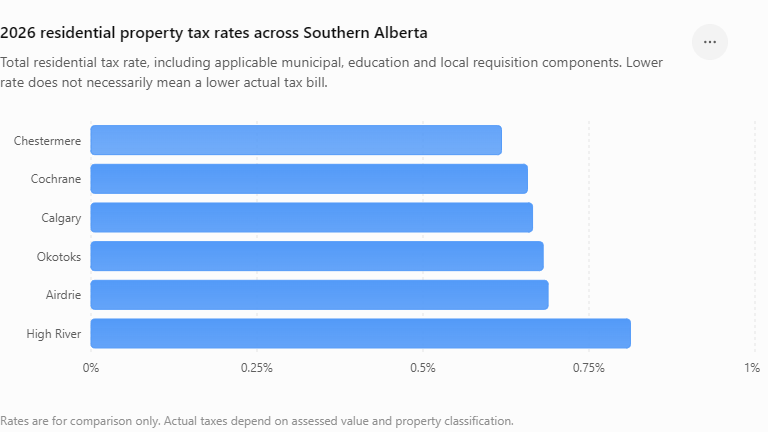
- Chestermere: approximately 0.6182%
- Cochrane: approximately 0.6573%
- Calgary: approximately 0.6650%
- Okotoks: approximately 0.6810%
- Airdrie: approximately 0.6884%
- High River: approximately 0.8124%
To put that into perspective, if we used a hypothetical $500,000 assessed value, the tax amounts would range from roughly $3,091 in Chestermere to approximately $4,062 in High River.
But here’s the important part: this is only a comparison exercise. It does not mean a $500,000 home exists in each community with identical characteristics, nor does it mean the average homeowner in each community pays those amounts.
Calgary Property Taxes
For 2026, Calgary’s total residential property tax rate is approximately 0.6650%.
Calgary’s 2026 median assessed value for a single-detached home is $706,000. Based on that median assessment, the total property tax bill is approximately $4,695, although the actual amount for an individual property will vary.
Calgary also provides a useful reminder about where your property tax dollars go. In 2026, approximately 58% of the residential property tax collected stays with the City, while approximately 42% is collected on behalf of the Province for education.
For buyers considering Calgary versus a surrounding community, the takeaway is simple: don’t look only at Calgary’s tax rate. Compare the actual assessment and expected annual tax bill for the specific homes you’re considering.
Airdrie Property Taxes
Airdrie’s 2026 residential tax rate is approximately 0.6884%.
The City of Airdrie’s published 2026 rate includes municipal taxes, provincial education taxes and other public requisitions.
For example, Airdrie uses a $614,000 assessed property in its tax example, which produces approximately $4,227 in total property taxes based on the 2026 rate.
Airdrie can be attractive to buyers looking for a suburban lifestyle and potentially lower home prices than some Calgary neighbourhoods. But when comparing affordability, remember to add property taxes to the mortgage payment, utilities, insurance and transportation costs.
Cochrane Property Taxes
Cochrane’s 2026 total residential tax rate is approximately 0.6573%.
The Town reports a 2026 median assessed value of $674,800 for a single-family dwelling. The total property tax bill on that median assessment is approximately $4,435, including municipal, provincial education and Rocky View Foundation amounts.
Interestingly, Cochrane’s 2026 municipal tax increase was relatively modest compared with the increase in its provincial education portion. The Town reported that the provincial education component increased by approximately 14.89% in 2026.
This is an important distinction for homeowners: not every increase on your property tax bill is controlled by your municipality.
Okotoks Property Taxes
Okotoks has a 2026 residential municipal tax rate of approximately 0.4150%. When the provincial education rate and Westwinds Communities requisition are included, the combined rate is approximately 0.6810%.
For 2026, the Town reported an average Okotoks home assessment of approximately $729,500.
Okotoks also reported that the provincial education tax was a major contributor to the increase in homeowners’ bills in 2026. For an average home, the provincial education portion was approximately $1,880.
This is another great example of why comparing only the municipal rate doesn’t tell the whole story.
Chestermere Property Taxes
Chestermere has one of the lower total residential property tax rates in this comparison at approximately 0.6182% for 2026.
The 2026 rate is made up of a municipal residential rate of approximately 0.3573% and a provincial education rate of approximately 0.2609%, along with the applicable local requisition.
Chestermere’s lower tax rate can look appealing, but buyers should be careful not to assume that means lower overall housing costs.
Chestermere properties can have higher assessed values, particularly for newer homes and properties with lake-related premiums. A lower tax rate applied to a higher-value property can still result in a substantial annual tax bill.
High River Property Taxes
High River has the highest total residential rate among the six communities in this comparison at approximately 0.8124% for 2026.
The Town’s published 2026 residential rates include a municipal rate of 5.3248 mills, an Alberta education rate of 2.7153 mills and a seniors’ requisition of 0.0838 mills.
That doesn’t automatically make High River a less affordable place to buy.
If the purchase price and assessed value of a High River property are lower than comparable properties in another community, the total annual tax bill may still be competitive.
This is why looking at the complete housing budget is much more useful than looking at one percentage.
So Which Community Has the Lowest Property Taxes?
If we’re comparing the 2026 total residential tax rates alone, Chestermere comes out lowest among these six communities.
High River has the highest rate in this particular comparison.
But does that mean Chestermere is automatically the cheapest place to own a home?
No.
And that’s one of the biggest points we want buyers to take away from this comparison.
A tax rate is only one part of the equation.
Property Tax Rate vs. Property Tax Bill: What’s the Difference? 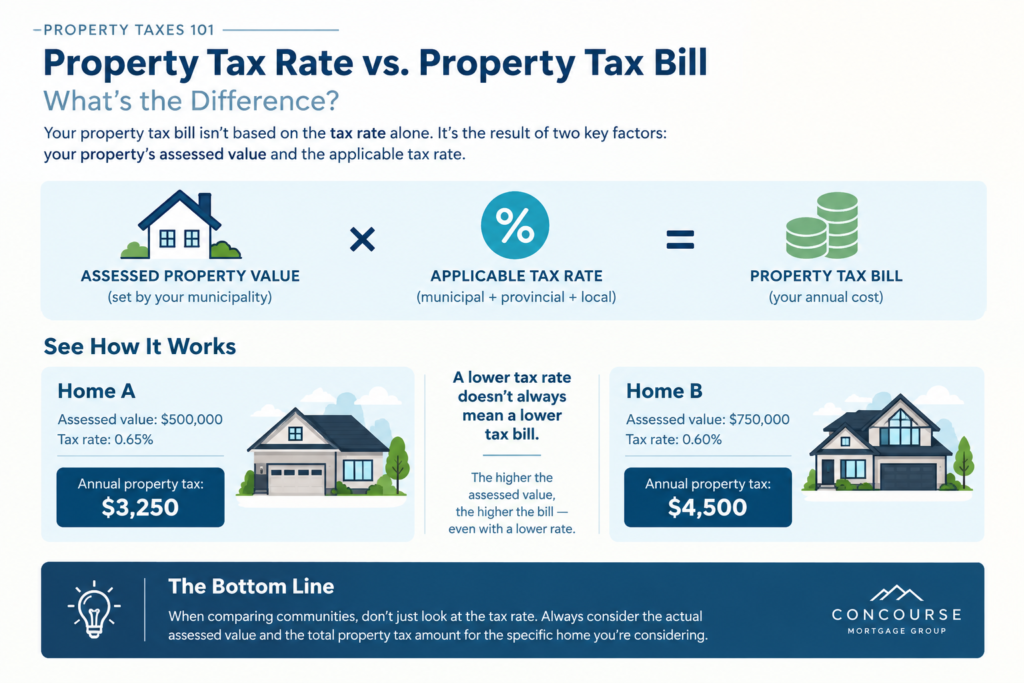
Imagine two homes:
- Home A is assessed at $500,000 and has a 0.65% total tax rate.
- Home B is assessed at $750,000 and has a 0.60% total tax rate.
Home B has the lower tax rate, but its annual property tax would still be higher because the rate is being applied to a much larger assessment.
This is why buyers should ask for the actual property tax amount for the specific home they’re considering rather than relying only on a community-wide tax rate.
What Should Buyers Budget For Besides Property Taxes?
Property taxes are only one part of your monthly housing costs.
When you’re determining what you can comfortably afford, remember to consider:
- Mortgage payment
- Property taxes
- Home insurance
- Utilities
- Condo or HOA fees, if applicable
- Maintenance and repairs
- Commuting and transportation costs
- Potential renovations or upgrades
- Emergency savings
For buyers moving from Calgary to a surrounding community, transportation can be particularly important. A home that saves you $100 per month in property taxes isn’t necessarily saving money if the commute adds several hundred dollars per month in fuel, vehicle costs and time.
Do Property Taxes Affect Mortgage Qualification?
They can.
When you’re applying for a mortgage, lenders look at your overall housing costs and your ability to carry the debt.
Property taxes form part of the overall cost of owning the property, which means they shouldn’t be forgotten when you’re creating a realistic home-buying budget.
This is particularly important when comparing homes in different municipalities. A slightly lower purchase price doesn’t necessarily mean lower monthly carrying costs if the property has significantly higher taxes, condo fees or other expenses.
What About Property Assessments?
Your property tax bill is based on your municipality’s assessment of the property, not necessarily what you paid for it.
Alberta municipalities use assessed values to determine each property’s share of the tax levy.
That means a change in your assessment doesn’t automatically mean your property taxes will increase by the same percentage.
For example, if every property in a community increased in assessed value by approximately the same amount, each property’s share of the overall tax burden could remain relatively similar.
What matters is how your property’s assessment changes compared with the overall assessment base, along with changes to the municipal budget and provincial education requisition.
Which Southern Alberta Community Is Right for You?
There isn’t one community that is automatically the best choice for every buyer.
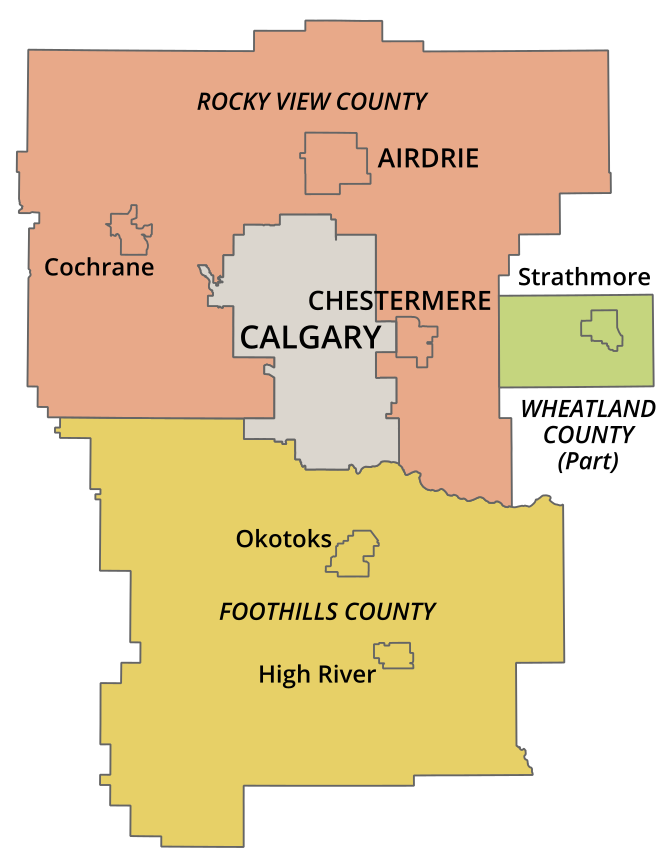
Calgary may make sense for buyers who value access to employment centres, transit, amenities and established neighbourhoods.
Airdrie can appeal to buyers looking for a growing suburban community north of Calgary.
Cochrane offers a smaller-community feel with easy access to Calgary and the Rocky Mountains.
Okotoks is popular with buyers looking for a community south of Calgary with a strong small-town feel and extensive amenities.
Chestermere offers proximity to Calgary along with its unique lake lifestyle.
High River can appeal to buyers looking for a smaller-town environment farther south of Calgary.
The right choice ultimately comes down to the combination of purchase price, property taxes, mortgage costs, commute, lifestyle and long-term goals.
The Bottom Line
Property taxes are easy to overlook when you’re focused on finding the right house, but they can make a meaningful difference to your monthly and annual housing costs.
For 2026, the total residential tax rates among Calgary, Airdrie, Cochrane, Okotoks, Chestermere and High River vary considerably.
However, don’t choose a community based on the tax rate alone.
Look at the actual assessed value and property tax bill for the home you’re considering, then factor that amount into your complete homeownership budget.
Because at the end of the day, the cheapest tax rate doesn’t necessarily mean the cheapest home to own.
Thinking About Buying in Calgary or Southern Alberta?
If you’re comparing Calgary with Airdrie, Cochrane, Okotoks, Chestermere or High River, the team at Concourse Mortgage Group can help you understand the financing side of the equation and make sure your home-buying budget considers more than just the purchase price.
Before you fall in love with the house, make sure you understand the whole cost of owning it.
That’s where a good mortgage conversation can make a big difference.
Frequently Asked Questions
Which Southern Alberta community has the lowest property tax rate?
Among the six communities compared in this article, Chestermere has the lowest 2026 total residential property tax rate at approximately 0.6182%.
Which community has the highest property tax rate?
High River has the highest 2026 total residential rate among the six communities compared, at approximately 0.8124%.
Does a lower property tax rate mean I will pay less property tax?
Not necessarily. Your tax bill depends on both the applicable tax rate and your property’s assessed value. A higher-value property with a lower tax rate can still have a higher annual tax bill.
Does my property assessment determine my tax rate?
No. Municipal councils establish municipal tax rates as part of their annual budgeting and taxation process. Your assessment determines your property’s share of the tax levy.
Are Alberta education taxes included in my property tax bill?
Yes. Municipalities collect provincial education taxes from property owners and remit those funds to the Government of Alberta.
Can property taxes change from year to year?
Yes. Property tax bills can change because of changes to your property’s assessment, municipal budgets, tax rates and provincial education requisitions.
Note: Property tax rates and assessments can change annually. The figures in this article are based on 2026 rates and are intended for general educational purposes. Buyers should confirm the current tax amount and assessment for a specific property before making a purchasing decision.